
How to Style a Moroccan Rug in a Modern American Home

Styling Guide
How to Style a Moroccan Rug in a Modern American Home
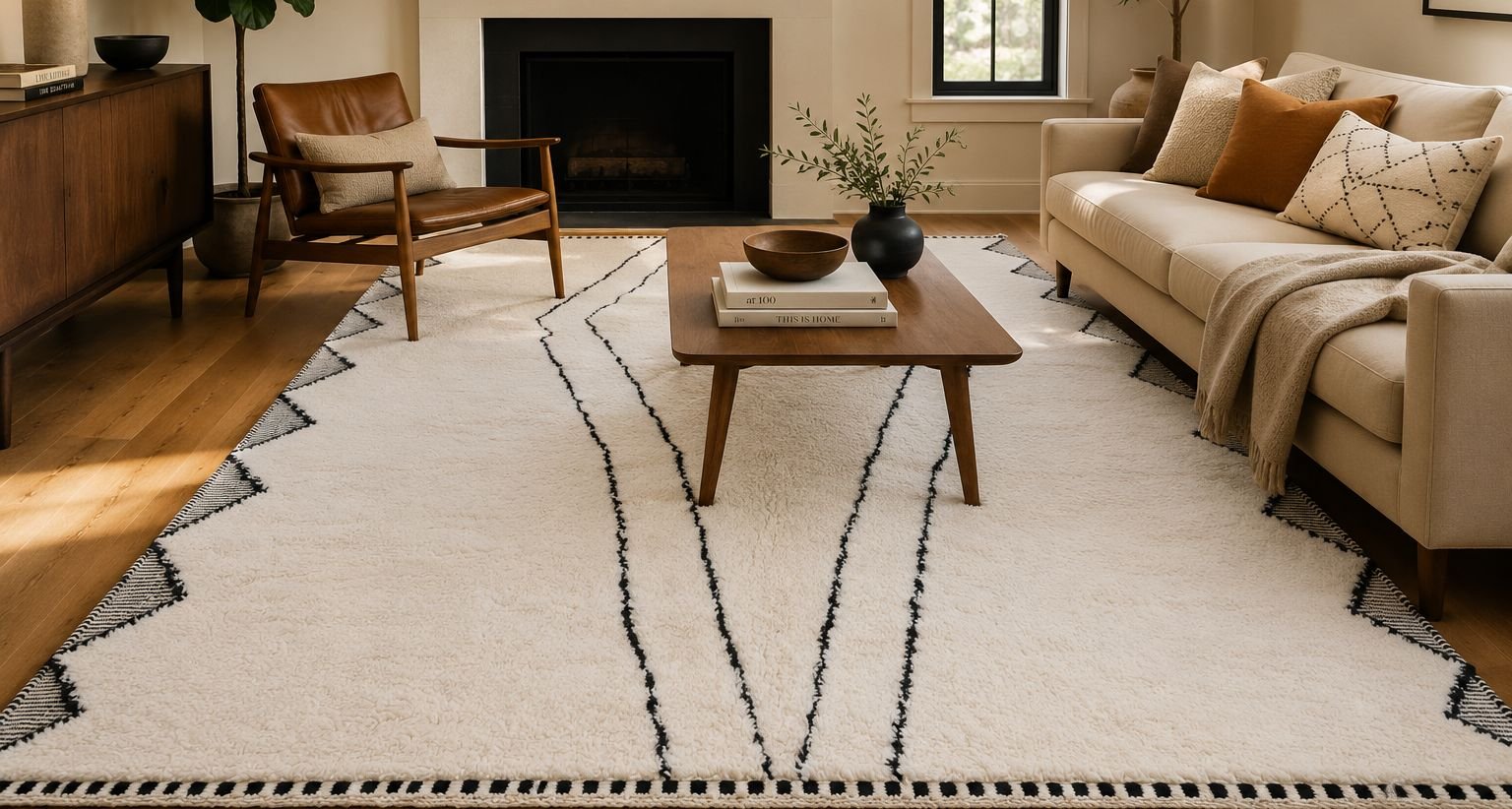
The berber rug doesn't need a Moroccan-themed room. Here's how to make it work in any interior — from a mid-century Austin living room to a minimalist Dallas loft.
By Sarah · Craftura Journal · 8 min read
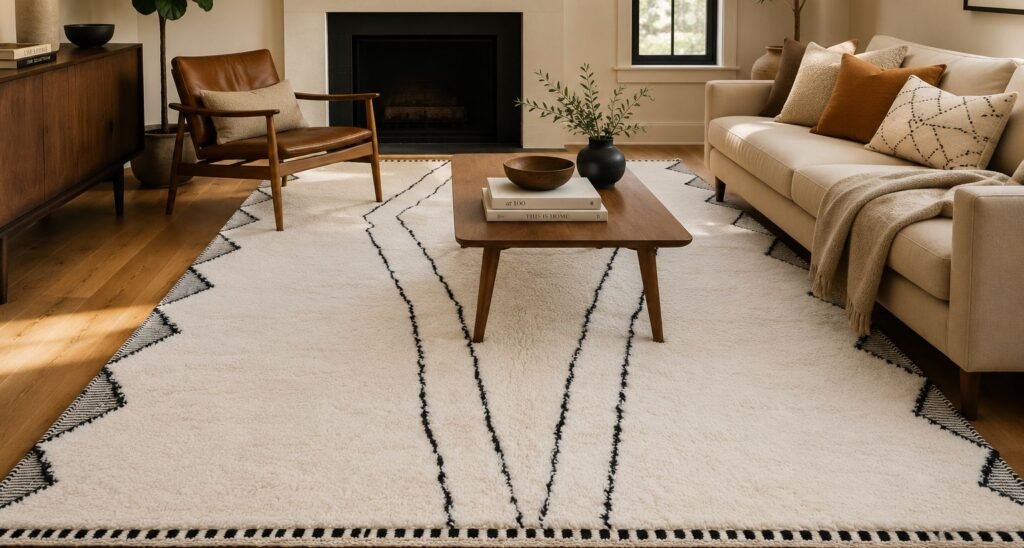
A common mistake people make when considering a moroccan rug is assuming it requires an entire boho or Moroccan-themed room to look right. In reality, nothing could be further from the truth. A handmade moroccan rug — whether it's a Beni Ourain rug, a kilim, or a boucherouite — is one of the most versatile pieces you can bring into a modern home. These rugs were made to live in homes, not in showrooms, and they adapt remarkably well to whatever room they inhabit.
The reason for this versatility lies in what moroccan rugs are made of, visually and physically. They are rooted in geometry, natural materials, and a restrained, often earth-driven color palette. Those qualities make them inherently compatible with a wide range of design languages — mid-century modern, Scandinavian minimalism, warm transitional, industrial loft. Each of these styles shares at least one of the qualities embedded in a traditional moroccan rug: an appreciation for honest materials, a preference for proportion over ornament, or a natural color ground.
What follows are five practical principles for styling an authentic moroccan rug in a modern American home. Each comes with a specific technique you can apply today — whether you're starting from scratch or working with a room that's already furnished. By the end, you'll know exactly how to make a moroccan rug the anchor of any space.
1. Let the Rug Set the Color Temperature of the Room
The first thing a moroccan rug does when it enters a room is set a color temperature. A Beni Ourain rug — cream wool with bold black geometric pattern — reads cool-neutral and works beautifully in rooms with white oak floors, linen sofas, and matte black hardware. The restraint of the palette means it never competes; it simply grounds. A warm-toned kilim in terracotta and sand does the opposite — it pulls the entire room toward warmth and pairs naturally with cognac leather, warm timber, and aged brass fixtures.
Before buying a moroccan area rug, pull a dominant color from it and hold it against your largest fixed surface — the sofa, the floor, the wall. They don't need to match. They need to not fight. A useful working rule: if your room is already reading warm (honey wood floors, warm whites, caramel upholstery), choose a rug that contains at least one cool neutral in its palette. That contrast creates breathing room and stops the room from feeling heavy. The reverse applies equally: a cool, grey-toned interior benefits enormously from a rug with even a trace of ochre, rust, or terracotta.
Understanding the natural color ranges of different moroccan rug types helps you narrow the field quickly. Beni Ourain rugs are ivory and charcoal — the most neutral option and the easiest to integrate into any palette. Azilal rugs are multicolor on white, more playful and expressive. High Atlas kilims run earthy — terracotta, rust, burnt orange, warm ochre. Boucherouite rugs are made from recycled textile and tend toward the vibrant and eclectic, with colors that often surprise. Each type has its own color logic, and knowing it saves you from a mismatch.
2. Size the Rug to Anchor, Not to Fill
The most common sizing mistake is buying a rug too small and floating it in the middle of the room like an island. A moroccan area rug should anchor the seating group, not decorate the floor between pieces of furniture. In a living room, this typically means an 8×10 ft or larger rug with all front legs of the sofa and chairs sitting on it. When you see a rug peeking out only from under the coffee table, the room reads as unfinished — even if everything else is beautifully chosen.
A practical sizing guide by room: For a living room seating group, start at 8×10 ft and go to 9×12 ft for larger spaces. For a dining room, the rug should extend at least 24 inches beyond all sides of the table — enough that chair legs stay on the rug when pulled out. For a bedroom under the bed, a 9×12 ft rug allows 18–24 inches of rug to show on the sides and at the foot. For a hallway or entryway, a moroccan runner rug in a 2.5×8 ft or 2.5×10 ft keeps things proportional without overwhelming the space.
If you are not sure of the right size, use painter's tape on the floor to map out the rug dimensions before you order. It takes five minutes and removes all guesswork — you'll immediately see whether 8×10 feels right or whether you actually need a 9×12. For rooms with unusual proportions or furniture arrangements, Craftura also offers a custom rug option, where size, pile, and pattern are made to your specification.
Quick Tip
Not sure what size to order? Use painter's tape on your floor to mark the exact dimensions of the rug before you buy. A 5-minute test that eliminates guesswork — and saves a return.
3. Mix Patterns — But Follow the Scale Rule
A moroccan rug is a pattern piece. Many homeowners are afraid to mix it with other patterns in the room — throw pillows, curtains, upholstery — convinced the room will become chaotic. That fear is unfounded if you follow one rule: vary the scale. A large-scale geometric berber rug pairs beautifully with a small-scale stripe or subtle texture on a pillow. They share the same frame but occupy entirely different visual scales, so they don't compete. The eye reads them as different layers rather than a clash.
What to avoid: two large-scale geometric patterns in the same field of view. A bold kilim rug under a large-pattern upholstered sofa is asking for a fight — one will win and the other will look like a mistake. The rule of thumb is to let the moroccan rug be the pattern hero of the floor plane and keep upholstery either solid or subtly textured. A boucle sofa, a linen chair, a wool throw — these are all pattern-neutral in the right sense of the word.
Color is the connecting thread that makes pattern mixing feel intentional rather than accidental. Even when you're mixing two or three different patterns in a room, pull one color that appears in the rug and repeat it at least twice elsewhere — a cushion, a ceramic vase, the spine of a book on the coffee table. This creates visual coherence without making the room feel rigidly matchy-matchy. The room feels considered. That's the goal.
"A handmade moroccan rug is already doing the work of three decorative objects at once — color, texture, and pattern. Give it room to breathe and let everything else in the room support it."— Sarah, Founder of Craftura
4. Layer Texture, Not Just Color
One of the reasons handmade moroccan rugs work so well in modern interiors is texture — not pattern, not color, but the physical quality of the material itself. A hand-knotted Beni Ourain rug has a high, uneven wool pile that catches light differently across the day. In morning light it's soft and luminous. In the afternoon it reads almost sculptural. That tactile depth is something no machine-made or printed rug can replicate, and in a room that already has smooth, uniform surfaces — polished concrete, lacquered cabinets, glass tabletops — this organic variation is genuinely grounding.
Building a layered texture scheme around a moroccan rug follows a simple logic. The rug — whether high-pile wool or flat-woven kilim — establishes the base texture. From there, add a linen or cotton throw on the sofa for a softer, lighter layer. Introduce a rattan or cane element for an organic, natural counterpoint: a side table, a pendant lampshade, a woven tray. Then bring in a hard, reflective surface: a brass lamp, a hammered copper tray, a lantern with a patinated finish. Each material is from a different world — fiber, plant, metal — and the contrast between them is what makes the room feel rich.
The governing principle is this: every texture layer should have a different visual weight. The moroccan rug is heavy and grounding. The linen is light and airy. The rattan is dry and structural. The metal is hard and precise. Assembled together, they create a room that feels considered rather than simply purchased. The rug started that conversation — everything else answers it.
5. Placement Beyond the Living Room
Most people think first of the moroccan rug living room setup, but a well-chosen moroccan rug works brilliantly in every room of the house. In the bedroom, a large Beni Ourain or neutral kilim placed under the bed transforms the space from a sleeping room to a retreat — the soft, textured pile underfoot when you wake up is a different experience than cold hardwood or plain carpet. In the dining room, a flat-woven kilim is often the most practical choice: it sits better under chair legs than a high-pile rug, it's easier to clean, and it still brings the full visual richness of moroccan home decor to the table.
The entryway is where a moroccan runner rug earns its keep. It is the first thing a guest sees when they walk in and the last detail they notice on the way out — which means it sets the tone for the entire home. A well-chosen runner in a hallway signals intention and warmth before anyone has sat down. Choose something with a bold geometric pattern: it reads well even in a narrow space, where a large-format rug would feel cramped. A High Atlas kilim runner in earthy terracotta or rust is a strong choice for this position.
The home office — increasingly the most personal room in the house — is another overlooked placement. A small moroccan rug, a 4×6 ft or 5×8 ft, under a desk and chair adds warmth to what is often a utilitarian space. It signals that the room was thought about, not just set up. Even a 3×5 ft boucherouite rug under a reading chair brings something irreplaceable: the sense that the room is inhabited, not just functional.
For the Dining Room
Choose a flat-woven kilim over a high-pile rug under a dining table. It sits better under chair legs, is easier to clean, and still brings all the pattern and color of a handmade moroccan rug into the space.
Finding the Right Moroccan Rug for Your Home
The secret to styling a moroccan rug in a modern American home has nothing to do with matching a theme. It has everything to do with understanding what the rug does — it anchors a seating group, it sets a color temperature, it introduces a scale of pattern, it adds a layer of texture that no other object in the room can replicate — and then letting the rest of the room respond to it. The five principles in this guide are five ways of doing exactly that: reading what the rug brings and building outward from it.
At Craftura, every rug is personally sourced from artisan workshops across Morocco — each piece selected for its quality, its craft, and its adaptability to the American home. If you're not yet sure which type is right for your space, our find the right rug for you guide walks you through it by room, style, and budget. Or if you have a specific size or color in mind that you haven't been able to find, our custom moroccan rug option lets you work directly with the source.
Ready to Find Yours?
Browse Handmade Moroccan Rugs, Sourced Directly from Morocco
Berber, kilim, boucherouite and made-to-order. Every piece with a name, a region and a story.
Shop Moroccan Rugs Or design a custom rug for your exact space →Sarah
Founder, Craftura · Austin, Texas
Sarah discovered Moroccan craftsmanship on a trip to Marrakech and has been sourcing directly from artisan workshops ever since. She writes about Moroccan interior design, rug styling and the craft behind every piece.
Keep Reading
More From the Craftura Journal
Buying Guide
Berber Rug vs Kilim: What's the Difference and Which One Is Right for You?
Both are handmade. Both are Moroccan. But they're built differently…
Read more →Craft Stories
Inside a Fès Copper Workshop: The Artisans Behind Your Faucet
The medina of Fès has been home to copper-smiths for centuries…
Read more →Styling Guide
How to Layer Rugs: The Moroccan Art of Stacking Textiles
Layering rugs is a centuries-old Moroccan tradition that works beautifully in modern rooms…
Read more →Craftura — Moroccan craftsmanship, Texan soul.